Bluetooth LE reaches orbit + UWB goes 4x farther
Plus: Digital Key v4 testing, Windows 11 LE Audio sharing, and blueAI's launch list
This Week in Bluetooth & UWB |
June 12, 2026 |
|
In This Issue
→ blueAI, the AI debugging copilot
→ An Edge AI MCU with Bluetooth 6.0 → Bluetooth LE talks to satellites → Digital Key v4 enters testing → UWB ranging goes 4x farther |
|
|
A Novel Bits tool · launching soon
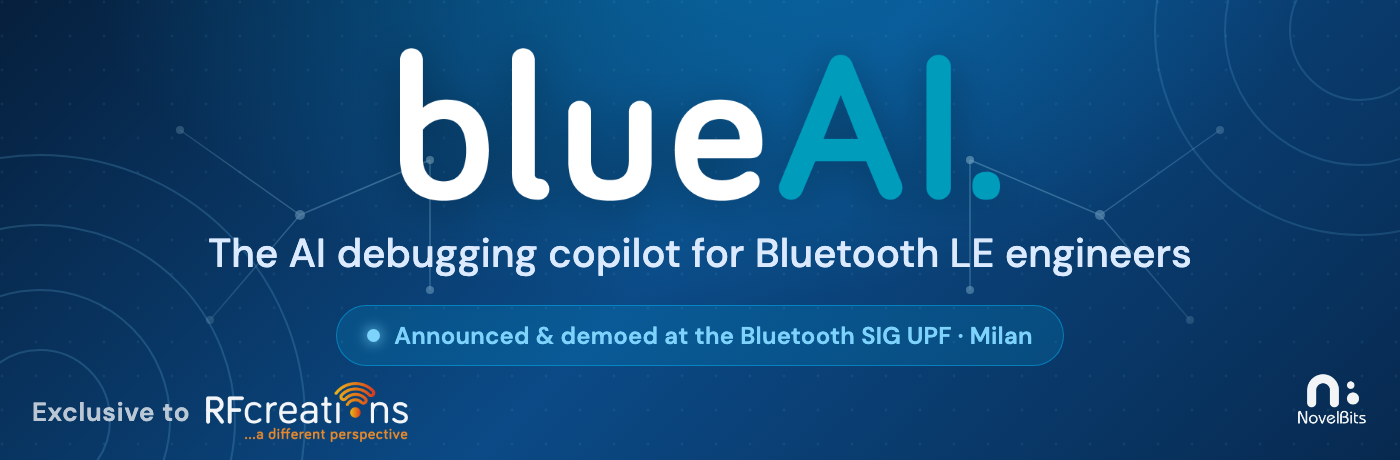
blueAI: the AI debugging copilot for Bluetooth LE
Quick follow-up from last week: at the Bluetooth SIG UPF in Milan, I announced blueAI, my AI debugging copilot. If you missed it, here's the short version: blueAI reads your capture, reasons about the protocol, and cites the Bluetooth Core Specification, so root-cause hunts take minutes instead of hours.
It works hand-in-hand with the blueSPY sniffer, on live captures or the .pcapng files you already have. If you've ever lost an afternoon to a mystery disconnect or a pairing failure, this is the tool I built because I was tired of doing that by hand. It launches soon as a commercial tool, so join the launch list and you'll get early access and pricing before it's public, plus a walkthrough from me.
|
Bluetooth LE
|
CNX-Software
Synaptics has introduced the Astra SRW1500 Series of AI-native Edge AI MCUs designed for smart IoT edge devices. The family features an Arm Cortex-M52 core, an optional Arm Ethos-U55 Neural Processing Unit (NPU), and tri-band Wi-Fi 7 or Wi-Fi 6, Bluetooth 6.0 LE, and 802.15.4 connectivity, in a single package. Since sensing, AI processing, and wireless connectivity are integrated into a single chip, this approach helps reduce system costs, simplify PCB design, and lower power consumption in devices such as smart home hubs, building automation systems, and home appliances.
|
|
TipRanks
Hubble Network continued to detail its firmware-based approach to global IoT connectivity this week, highlighting how standard Bluetooth Low Energy chips can be upgraded to communicate directly with low Earth orbit satellites. By narrowing and slowing the signal and using satellite-side phased array antennas, the company aims to move small data packets from existing hardware without added modems. The firm is also expanding its partnership with InPlay to enable sub-$1, Bluetooth LE-based smart labels for cold-chain and high-value shipments.
|
|
Business Wire
The Car Connectivity Consortium (CCC) is hosting its 18th end-to-end interoperability Plugfest this week at the automotive test center of DEKRA Lausitzring in Germany to advance testing and validation of CCC Digital Key implementations. New additions include CCC Digital Key v4 test cases, enabling deeper validation of next-generation implementations; updated Near Field Communications (NFC) test cases, available for the first time at a Plugfest; and Bluetooth Low Energy (LE) sniffing techniques. Participants include Apple, BMW Group, and Google.
|
|
Windows Latest
When you turn on Shared audio via Quick Settings in Windows, you can connect two Bluetooth devices and share the system's audio to the two connected devices. Right now, Windows does not allow you to play audio via two connected Bluetooth devices, but that changes with today's update, and it's all possible due to Bluetooth LE audio technology. In Quick Settings, tap Shared audio, then select two supported devices to start sharing audio wirelessly.
|
|
CNX-Software
AkiraOS is a Zephyr-based embedded OS that runs sandboxed WebAssembly applications on microcontrollers and lets users deploy and update firmware OTA without reflashing. In other words, it's similar to Docker containers, but for microcontrollers. The open-source embedded platform separates the OS from the application. Its network stack includes HTTP for OTA updates and Bluetooth LE for AkiraMesh, and supported hardware includes the Nordic nRF54L15 Arm Cortex-M33 MCU with Bluetooth LE 5.4.
|
Ultra-Wideband (UWB)
|
IoT Insider
The Belgian research institute imec has unveiled what it says is the world's first narrowband receiver chip compliant with the upcoming IEEE 802.15.4ab ultra-wideband (UWB) standard. According to imec, the receiver enables a fourfold increase in UWB ranging distance while maintaining low power consumption and resilience against interference from nearby Wi-Fi networks. The design was fabricated using a 22nm CMOS process and consumes less than 6mW of power.
|
|
Automotive World
Calterah has launched two millimetre-wave (mmWave) radar chips for automotive safety and a new ultra-wideband (UWB) radar platform, unveiled at Calterah Day on 5 June 2026. The UWB platform centres on the CAL1106AQ, what Calterah claims is the world's first 2T4R UWB SoC compliant with IEEE 802.15.4ab Sensing and certified to FiRa 4.0. The chip underpins development suites for child presence detection and parking assist; Calterah says both exceed conventional UWB capability.
|
P.S. AkiraOS runs sandboxed WebAssembly apps on microcontrollers and updates them OTA without a reflash, even on the nRF54L15. Genuinely useful, or a layer too far for embedded? I'd love to hear your gut reaction.
— Mohammad Afaneh
Don't miss what's next. Subscribe to Novel Bits:
