
blueAI just announced + Channel Sounding vs UWB
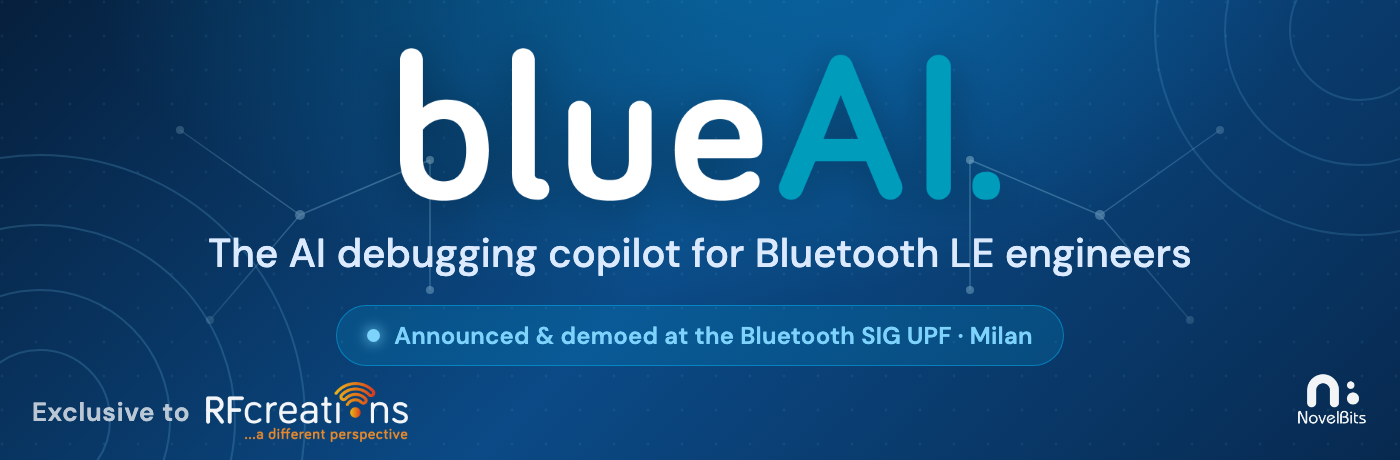
blueAI, just announced and demoed at the Bluetooth UPF in Milan, exclusive to RFcreations.
This Week in Bluetooth & UWB |
June 5, 2026 |
|
In This Issue
→ blueAI, announced in Milan
→ Channel Sounding goes sub-meter → A world-first Bluetooth ESL chip → $40 board: Wi-Fi 6 + Bluetooth 5 → Auracast comes to the theater → UWB powers an 8K keyboard |
|
|
Just announced · Bluetooth SIG UPF, Milan
blueAI: the AI debugging copilot for Bluetooth LE
Yesterday at the Bluetooth SIG UPF in Milan, I announced and demoed blueAI, the AI debugging copilot I built with RFcreations. It reads your capture, reasons about the protocol, and cites the Bluetooth Core Specification, so root-cause hunts take minutes instead of hours.
blueAI is exclusive to RFcreations and works hand-in-hand with their blueSPY sniffers, on live captures or the .pcapng files you already have. It's not generally available yet, but get on the launch list and I'll send the walkthrough the moment it ships.
|
Bluetooth LE
|
Bluetooth SIG Blog
Bluetooth Channel Sounding leverages procedures such as Phase-Based Ranging (PBR) (and optionally Round-Trip Timing (RTT)) to estimate the distance between two connected devices, aiming for sub-meter performance in many conditions where RSSI is not enough. It produces rich measurement data such as IQ samples (in-phase and quadrature components), enabling two implementation paths: use a built-in algorithm optimized for a module and faster time-to-market, or consume the raw measurements and build a custom ranging stack tuned to your application.
|
|
PR Newswire
Airoha is expanding its footprint in the "Short-range Wireless" IC market in 2026, officially extending its reach from audio into Bluetooth data transmission. Airoha is the world's first IC designer to realize the 4.2-inch Ripple ESL (Electronic Shelf Label) chip, demonstrating its exceptional wireless technology prowess in anti-interference and transmission reliability. Airoha Technology's newly launched AB161x series chips support all types of ESLs adopting the Bluetooth SIG 5.4 standard.
|
|
CNX-Software
Wireless-Tag has launched a Kickstarter campaign for the ESP32P4C61-TINY, a compact open-source AIoT development board that combines ESP32-P4 (general-purpose) and ESP32-C61 (wireless) RISC-V SoCs. It provides 2.4 GHz WiFi 6 and Bluetooth 5 via the ESP32-C61 SoC. The Super Early Bird tier is priced at around $40, a 51% discount from the $81.50 MSRP.
|
|
Rochester First (WROC)
Auracast will allow those who are hard of hearing to stream live audio from the West Herr Auditorium's sound system through Bluetooth broadcast technology. Hearing aids will be able to connect to Auracast, and headphones will be available to guests on a first-come, first-served basis. RBTL says Auracast being provided at the theater was made possible through the Hearing Loss Association – Rochester Chapter.
|
|
Liam O'Dell
The Royal National Institute for Deaf people (RNID) has launched a survey for theatre workers to share their experience with Auracast. Auracast allows for an unlimited number of compatible devices, such as hearing aids, headphones and earpods, to connect to one audio broadcast. RNID wants to make sure that users are at the heart of establishing what best practice looks, sounds and feels like.
|
Ultra-Wideband (UWB)
|
TechRadar
In its press release, Cherry announced the "first 8K Ultra-Wideband gaming keyboard," the XTRFY K63W Pro Compact. The keyboard comes with a "true 8,000 Hz polling rate," meaning it transmits data to a computer up to eight times every millisecond. The polling rate applies to both wired and wireless connections, with the latter being a strong Ultra-Wideband (UWB) dongle connection, paired with a 6,000 mAh battery, which Cherry claims lasts for 1,100 hours of usage.
|
|
EE Times Asia
Recent discussions on Bluetooth Channel Sounding and UWB increasingly converge on a practical question: which technology fits which use case. Both address ranging and positioning, but with different trade-offs in accuracy, cost, maturity and robustness. The industry is therefore moving toward a layered model, where different radios serve distinct roles. Rather than replacing UWB, Channel Sounding expands the addressable market for ranging, while UWB remains focused on high-precision and high-reliability applications.
|
P.S. This week's EE Times Asia piece frames Bluetooth Channel Sounding and UWB as complementary layers rather than rivals. If you're weighing the two for a ranging or access-control project, I'd love to hear which way you're leaning.
— Mohammad Afaneh
Don't miss what's next. Subscribe to Novel Bits:
