
LE Audio enters the operating room + FCC urged to modernize UWB rules
Plus: Espressif's most connected MCU yet, a $17M bet on LE-UWB, and DIY X-ray vision
|
This Week in Bluetooth & UWB
|
Mar 27,
2026
|
|
In This Issue
→ LE Audio enters the operating room
→ Espressif's most connected MCU yet → FCC urged to modernize UWB rules → DIY X-ray vision with UWB + radar → $17M bet on LE-UWB wireless |
BROUGHT TO YOU BY NORDIC SEMICONDUCTOR
|
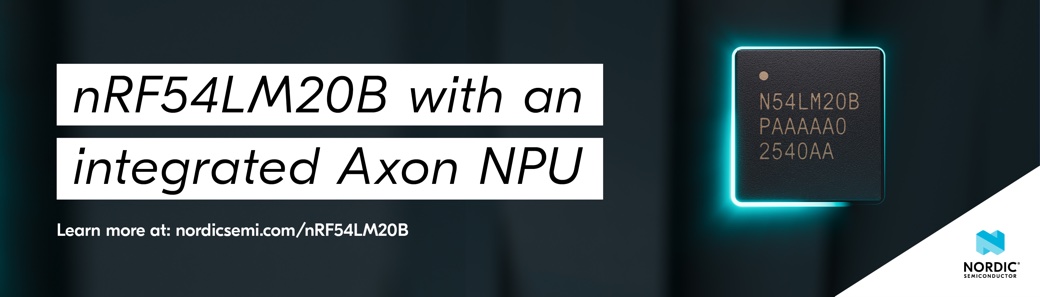
Nordic's new nRF54LM20B features an integrated Axon NPU, delivering up to 15x faster and 15x more energy-efficient
on-device inference for edge AI. With 2 MB of NVM, 512 KB of RAM, and an extended peripheral set, it provides the
headroom needed for advanced edge AI workloads at ultra-low power. The Axon NPU enables real-time intelligence for
applications like sensor fusion, anomaly detection, and voice or gesture recognition — all without relying on the
cloud.
| Explore the nRF54LM20B → |
Bluetooth LE
|
Electronics360
Blecon's new software solution, Blecon Agent, transforms Zebra Technologies devices already in the hands of
front-line workers into an autonomous Bluetooth tracking network with continuous asset visibility. The workforce
itself functions as the sensing layer, with visibility coming through the devices teams already carry, the
spaces they already move through and the workflows that already exist. No new infrastructure or worker skillsets
are required. "All of that real estate that is covered by the people who are on the front line is now also a
tracking and sensing network," explained CEO Simon Ford. Blecon Agent can be rolled out to a whole fleet
overnight.
|
|
Nordic Semiconductor
Remington Medical's VascuChek is a handheld, cordless ultrasound-based device that has been FDA cleared for
intraoperative use. It uses the Doppler effect to detect and listen to blood flow within blood vessels, allowing
surgeons to check whether blood is still flowing properly after repairing, bypassing or grafting a vessel. Both
the transceiver handpiece and speaker dock employ a u-blox NORA-B1 module built on Nordic's nRF5340 SoC,
enabling Bluetooth LE Audio wireless connectivity. "We were initially skeptical that LE Audio could deliver high
sound quality and minimal latency while also being low-power," says Michael Fuller, Principal R&D Electrical
Engineer. "We were impressed that the nRF5340 SoC had sound quality right on par with the best Bluetooth Classic
alternative, while also having the lowest latency."
|
|
CNX Software
Espressif's upcoming ESP32-S31 is a dual-core RISC-V microcontroller featuring one high-performance core with
FPU and SIMD instructions, and one low-power core. It combines Gigabit Ethernet, 2.4 GHz Wi-Fi, Bluetooth, and
802.15.4 for Zigbee, Thread, and Matter. The chip includes 512 KB of SRAM, support for external octal PSRAM and
flash up to 64 MB, a 2D graphics accelerator, and JPEG codec support. With 62 GPIO pins — more than any other
ESP32 variant — it's Espressif's most versatile wireless SoC to date.
|
|
New Electronics
Avnet-owned Tria Technologies introduced two wireless modules for embedded systems. The SPB611 offers dual-band
Wi-Fi 6 and Bluetooth 5.2 with an optional tri-radio configuration adding 802.15.4 support for Thread and
Zigbee. Both modules arrive in a compact 14 x 14 mm package, operate across industrial temperature ranges (-40
to +85°C), and come pre-certified to accelerate time-to-market.
|
|
Windows Blog
The latest Windows 11 Canary build expands LE Audio shared audio support with three new accessories: Samsung
Galaxy Buds 4 and Buds 4 Pro, Sony WF-1000XM6, and Xbox Wireless Headset. The update also adds individual volume
sliders for each listener, allowing independent volume adjustment without affecting the other. A new taskbar
indicator appears while audio is being shared, offering quick access to sharing settings.
|
|
MakeUseOf
Auracast enables one device to broadcast audio to multiple receivers simultaneously with cross-platform
compatibility. Built on Bluetooth LE Audio using the LC3 codec, it offers high-quality sound with minimal
latency and extended battery life compared to traditional Bluetooth. Android 16 now supports Auracast, making it
accessible to mainstream users with compatible devices. The author highlights transformative potential for
public spaces — stadiums, museums, and airports could deliver personalized audio to many listeners at once.
|
Ultra-Wideband (UWB)
|
Embedded
NXP's new omlox RTLS Starter Kit integrates UWB hardware, localization software, and analytics for scalable
industrial positioning. Powered by the Trimension SR048 UWB SoC, the kit includes UWB tags and anchors
supporting TDoA, RToF, and downlink TDoA modes, operating from -40°C to 115°C. Developed with SynchronicIT and
Flowcate, it enables asset tracking, robot guidance, worker safety zones, and indoor navigation — scalable from
pilot to full facility without hardware changes.
|
|
Hackster.io
A maker project combines millimeter wave radar sensors that detect human presence and subtle movements through
walls with ultra-wideband anchors for indoor positioning. Multiple ESP32 boards connect to mmWave sensors,
transmitting data wirelessly to a central hub. UWB anchors triangulate the wearer's position like a personal
indoor GPS. A robotic vacuum with LiDAR generated accurate floor plans, and an Android smartphone overlays
bounding boxes onto live video showing people's locations behind walls.
|
|
JD Supra
The FCC's original UWB regulations, established nearly 25 years ago, restrict outdoor devices to low-power,
handheld-only use. Modern applications like apartment doorframe security systems require individual waivers,
placing significant strain on FCC resources. A petition seeks permission for non-pulse-based modulations, fixed
outdoor uses not limited to handheld devices, and a duty cycle approach as an alternative to the existing
10-second transmission cessation requirement. The public comment period closed in February 2026.
|
|
Business Wire
Montreal-based SPARK Microsystems closed a CAD $17 million Series B follow-on financing round co-led by Idealist
Capital and Real Ventures. The investment fuels commercialization of LE-UWB (Low-Energy Ultra-Wideband)
technology, which offers ultra-low power, low latency, and high throughput for challenging RF environments.
Target applications include AI wearables, AR/VR headsets, gaming peripherals, industrial sensors, autonomous
robots, and medical devices. CEO Fares Mubarak says the funding accelerates delivery to innovators limited by
Bluetooth and Wi-Fi in power-constrained settings.
|
P.S. That UWB "see through walls" project is wild — the YouTube video showing the full
build is worth a watch. Has anyone tried combining mmWave radar with UWB anchors for indoor sensing?
Hit reply, I'd love to hear about it.
— Mohammad Afaneh
Don't miss what's next. Subscribe to Novel Bits:
